Is multimod_fast really correct?
This story starts with this piece of code:
// gcc test.c -o test -fwrapv
int64_t multimod_fast(int64_t a, int64_t b, int64_t m) {
    int64_t t = (a * b - (int64_t)((double)a * b / m) * m) % m;
    return t < 0 ? t + m : t;
}
Last night, someone sent me this code, claiming it could serve as a replacement for fast multiplication, and asked me to explain its correctness. This code supposedly reduces the time complexity from int64_t and double can lead to loss of precision, so I became skeptical about the correctness of this code.
Preliminaries
First, we need to understand how floating-point numbers are represented in C. The IEEE 754 standard specifies the representation of floating-point numbers. The double type occupies 64 bits, with 1 bit for the sign, 11 bits for the exponent, and the remaining 52 bits for the mantissa. You can refer to this article to learn more about floating-point numbers; I won't go into further detail here.
Next, we need to understand the role of the -fwrapv compilation option. According to the official GCC documentation, the -fwrapv option ensures that when signed integer overflow occurs, the result is the two's complement modulo. This means that when signed integers overflow, the result is truncated to a valid value. For example, INT_MAX + 1 results in INT_MIN.
Error Analysis
(double)a
Based on the knowledge learned earlier, it can be inferred that the relative precision of a 64-bit floating-point number is int64_t to double? We can use simple mathematical derivation to find the answer.
We know that the range of int64_t is int64_t to double, the maximum absolute error is approximately
Next, we can try to construct a test case to verify this conclusion:
#include <stdio.h>
#include <stdint.h>
#include <math.h>

int64_t a = 9223372036854775807;
double b;


int equal(double x, double y) {
  return fabs(x - y) < 0.0000001;
}

int judge(int64_t offset) {
  double c = (double)(a - offset);
  return equal(c, b);
}

int64_t bisect(int64_t low, int64_t high) {
  if (low == high) {
    return low - 1;
  }
  int64_t mid = (low + high) / 2;
  if (judge(mid)) {
    return bisect(mid + 1, high);
  } else {
    return bisect(low, mid);
  }
}

int main() {
  b = (double)a;
  printf("%ld\n", bisect(1, 1000000000));
  double c = (double)(a - 512);
  printf("%lf %lf\n", b, c);
  //printf("%d\n", equal(b, c));
  //printf("%d\n", judge(200000000));
  return 0;
}
Actual testing shows that when a = INT64_MIN, the valid range for the bisection offset is a = INT64_MAX, the valid range for the bisection offset is a is double value jumps from
(double)a * b
asm
Let's analyze how a double is multiplied by an int64_t with a simple code snippet:
int main() {
  int64_t a = 3;
  int64_t b = 4;
  double c = (double)a * b;
  return 0;
}
The disassembly in an x86_64 environment is as follows:
0000000000001119 <main>:
    1119:       55                      push   rbp
    111a:       48 89 e5                mov    rbp,rsp
    111d:       48 c7 45 e8 03 00 00    mov    QWORD PTR [rbp-0x18],0x3
    1124:       00
    1125:       48 c7 45 f0 04 00 00    mov    QWORD PTR [rbp-0x10],0x4
    112c:       00
    112d:       66 0f ef c9             pxor   xmm1,xmm1
    1131:       f2 48 0f 2a 4d e8       cvtsi2sd xmm1,QWORD PTR [rbp-0x18]
    1137:       66 0f ef c0             pxor   xmm0,xmm0
    113b:       f2 48 0f 2a 45 f0       cvtsi2sd xmm0,QWORD PTR [rbp-0x10]
    1141:       f2 0f 59 c1             mulsd  xmm0,xmm1
    1145:       f2 0f 11 45 f8          movsd  QWORD PTR [rbp-0x8],xmm0
    114a:       b8 00 00 00 00          mov    eax,0x0
    114f:       5d                      pop    rbp
    1150:       c3                      ret
Clearly, not everyone is familiar with the meanings of the pxor, cvtsi2sd, mulsd, and movsd instructions. Let's refer to the Intel manual:
pxor: Performs a bitwise XOR operation on floating-point registers (xmm?).cvtsi2sd: Converts anint64_tto adoubleand stores it in a floating-point register.mulsd: Multiplies twodoublevalues and stores the result in the first (destination) operand.movsd: Copies the source operand to the destination operand.
In GDB, set a breakpoint at 0x114a with b 0x114a, then continue. After the breakpoint is hit, the state of xmm0 is as follows:
(gdb) p $xmm0
$4 = {v8_bfloat16 = {0, 0, 0, 2.625, 0, 0, 0, 0}, v8_half = {0, 0, 0, 2.0781, 0, 0,
    0, 0}, v4_float = {0, 2.625, 0, 0}, v2_double = {12, 0}, v16_int8 = {0, 0, 0, 0,
    0, 0, 40, 64, 0, 0, 0, 0, 0, 0, 0, 0}, v8_int16 = {0, 0, 0, 16424, 0, 0, 0, 0},
  v4_int32 = {0, 1076363264, 0, 0}, v2_int64 = {4622945017495814144, 0},
  uint128 = 4622945017495814144}
Looking up the relevant data online, we find that converting the double value 4622945017495814144 back to int64_t gives the correct result: 12.
Actual Analysis
From the above, it can be inferred that the computation of (double)a * b involves converting both a and b to floating-point form and then executing the mulsd instruction.
Next, let's analyze the result of (double)a * b. We already know that when converting int64_t to double, the error range for the multiplier is
For the maximum value:
For the minimum value:
Let's write another piece of code to verify whether this conjecture is correct:
#include <stdio.h>
#include <stdint.h>
#include <math.h>

int64_t a = -9223372036854775808;
double b;


int equal(double x, double y) {
  printf("fabs(%lf - %lf) = %lf\n", x, y, fabs(x - y));
  return fabs(x - y) < 0.0000001;
}

int judge(int64_t offset) {
  double c = (double)(a + offset)*(a + offset);
  // should be (double)(a + offset)*(-a + offset) when getting the minimum
  return equal(c, b);
}

int64_t bisect(int64_t low, int64_t high) {
  if (low == high) {
    return low - 1;
  }
  int64_t mid = (low + high) / 2;
  if (judge(mid)) {
    return bisect(mid + 1, high);
  } else {
    return bisect(low, mid);
  }
}

int main() {
  // the "b" in context is another a in next line of code,
  // instead of the result on the left
  // should be (double)a*(-a) when getting the minimum
  b = (double)a*a;
  printf("%ld\n", bisect(1, 1000000000));
  //double c = (double)(a - 512);
  //printf("%lf %lf\n", b, c);
  //printf("%d\n", equal(b, c));
  //printf("%d\n", judge(200000000));
  return 0;
}
The verification results show that the valid range of values for a and b remains unchanged. When a = b = INT64_MIN and offset = 512, the maximum absolute error is calculated to be a = INT64_MAX, b = -INT64_MAX and offset = -511, the minimum absolute error is calculated to be
In summary, our previous estimate is about half the actual absolute error, which is still acceptable.
(double)a * b / m
Division is somewhat tricky. According to the relative error formula, if
There is a relatively simple positive correlation between
For
We can observe that
Substituting back into the original expression (double)a * b / m, we can confirm that when a = b = INT64_MIN, m = 1 and a = b = INT64_MIN, m = -1, the absolute error range is
(int64_t)((double)a * b / m) * m
The absolute error of (double)a * b / m has already exceeded the range of int64_t itself, so theoretically, after converting to int64_t, there is no precision at all in the worst-case scenario.
Therefore, from a mathematical perspective, this function is not always valid. There is no further need to analyze it.
When it will satisfy
Let's then examine at what magnitudes of (int64_t)((double)a * b / m) * m will be divisible by
import random
import subprocess

matrix = [[1 for _ in range(62)] for _ in range(62)]


# try this multiple times to reduce the chance of false positive
for _ in range (10):

    A = []
    B = []
    C = []

    for i in range(0, 62):
        A.append(2**i + random.randint(max(-2**i+1, -10), min(2**i-1, 10)))

    for i in range(0, 62):
        B.append(2**i + random.randint(max(-2**i+1, -10), min(2**i-1, 10)))

    for i in range(0, 62):
        C.append(2**i + random.randint(max(-2**i+1, -10), min(2**i-1, 10)))

    lenA = len(A)
    lenC = len(C)


    for i in range(lenA):
        for j in range(lenC):
            command = ["./test", str(A[i]), str(B[i]), str(C[j])]
            result = subprocess.run(command, stdout=subprocess.PIPE)
            output = int(result.stdout.strip())
            if output % C[j] != 0:
                matrix[i][j] = 0 # invalid

import numpy as np
import matplotlib.pyplot as plt

colored_matrix = np.array(matrix)
plt.imshow(colored_matrix, cmap='Blues', interpolation='nearest')
plt.show()
#include <stdio.h>
#include <stdint.h>
#include <stdlib.h>
#include <math.h>


double f(int64_t x, int64_t y, int64_t z) {
  return (int64_t)((double)x * y / z) * z;
}

double g(int64_t x, int64_t y, int64_t z) {
  return (double)x * y / z;
}

int64_t h(int64_t x, int64_t y, int64_t z) {
  return (int64_t)((double)x * y / z) * z;
}

int64_t multimod_fast(int64_t a, int64_t b, int64_t m) {
    int64_t t = (a * b - (int64_t)((double)a * b / m) * m) % m;
    return t < 0 ? t + m : t;
}


int main(int argc, char *argv[]) {
  if (argc != 4) {
    return 1;
  }

  int64_t a = atol(argv[1]);
  int64_t b = atol(argv[2]);
  int64_t c = atol(argv[3]);

  printf("%ld\n", h(a, b, c));
  return 0;
}
The plotting result is as follows (the horizontal axis is
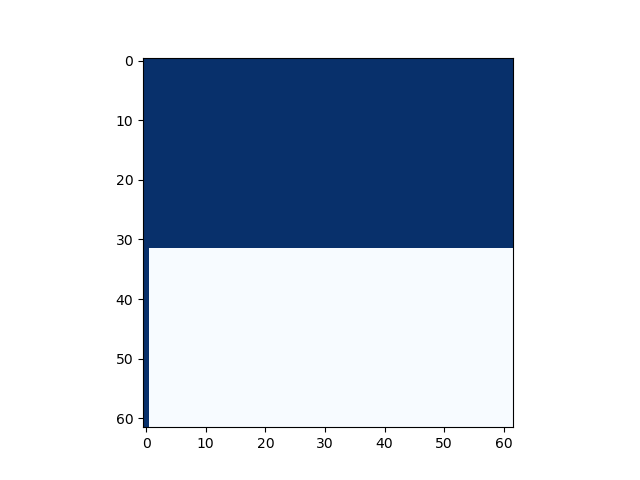
Let's slightly modify the code. Theoretically, if (int64_t)((double)a * b / m) * m is a multiple of (a * b - (int64_t)((double)a * b / m) * m) % m should simplify to (a * b) % m. That is, the entire multimod_fast is equivalent to the previous proposition, and the plotted graph should be consistent:
import random
import subprocess

matrix = [[1 for _ in range(62)] for _ in range(62)]


# try this multiple times to reduce the chance of false positive
for _ in range (10):

    A = []
    B = []
    C = []

    for i in range(0, 62):
        A.append(2**i + random.randint(max(-2**i+1, -10), min(2**i-1, 10)))

    for i in range(0, 62):
        B.append(2**i + random.randint(max(-2**i+1, -10), min(2**i-1, 10)))

    for i in range(0, 62):
        C.append(2**i + random.randint(max(-2**i+1, -10), min(2**i-1, 10)))

    lenA = len(A)
    lenC = len(C)


    for i in range(lenA):
        for j in range(lenC):
            command = ["./test", str(A[i]), str(B[i]), str(C[j])]
            result = subprocess.run(command, stdout=subprocess.PIPE)
            output = int(result.stdout.strip())
            if output != A[i] * B[i] % C[j]:
                matrix[i][j] = 0 # invalid

import numpy as np
import matplotlib.pyplot as plt

colored_matrix = np.array(matrix)
plt.imshow(colored_matrix, cmap='Blues', interpolation='nearest')
plt.show()
#include <stdio.h>
#include <stdint.h>
#include <stdlib.h>
#include <math.h>


double f(int64_t x, int64_t y, int64_t z) {
  return (int64_t)((double)x * y / z) * z;
}

double g(int64_t x, int64_t y, int64_t z) {
  return (double)x * y / z;
}

int64_t h(int64_t x, int64_t y, int64_t z) {
  return (int64_t)((double)x * y / z) * z;
}

int64_t multimod_fast(int64_t a, int64_t b, int64_t m) {
    int64_t t = (a * b - (int64_t)((double)a * b / m) * m) % m;
    return t < 0 ? t + m : t;
}


int main(int argc, char *argv[]) {
  if (argc != 4) {
    return 1;
  }

  int64_t a = atol(argv[1]);
  int64_t b = atol(argv[2]);
  int64_t c = atol(argv[3]);

  printf("%ld\n", multimod_fast(a, b, c));
  return 0;
}
However, the actual graph looks like this. We found that the previous expression is a sufficient condition and is not equivalent. Also, when
We can also provide a concrete counterexample: multimod_fast is
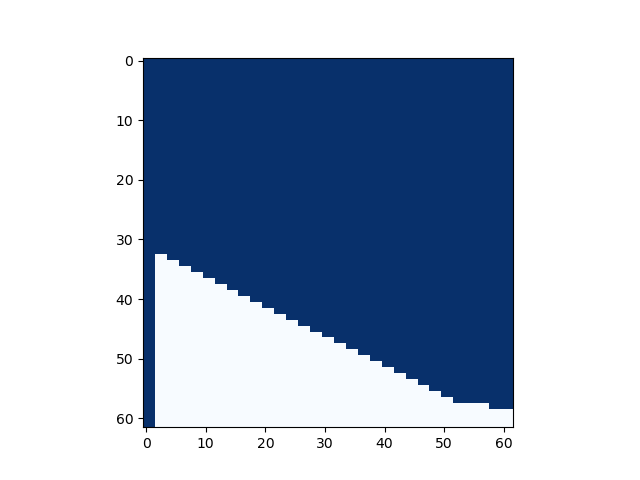
Overall, we can at least conclude that when
Proof
We previously stated that "(int64_t)((double)a * b / m) * m being a multiple of (int64_t)((double)a * b / m) * m is a multiple of
Some might question: isn't (int64_t)((double)a * b / m) definitely an integer? Then the expression in question must be a multiple of -fwrapv option, if
Therefore, as long as (int64_t)((double)a * b / m) * m must be a multiple of multimod_fast correctly performs its function, regardless of floating-point errors.
Summary
The expression multimod_fast is correct only when int64_t. It cannot fully replace the int64_t values of